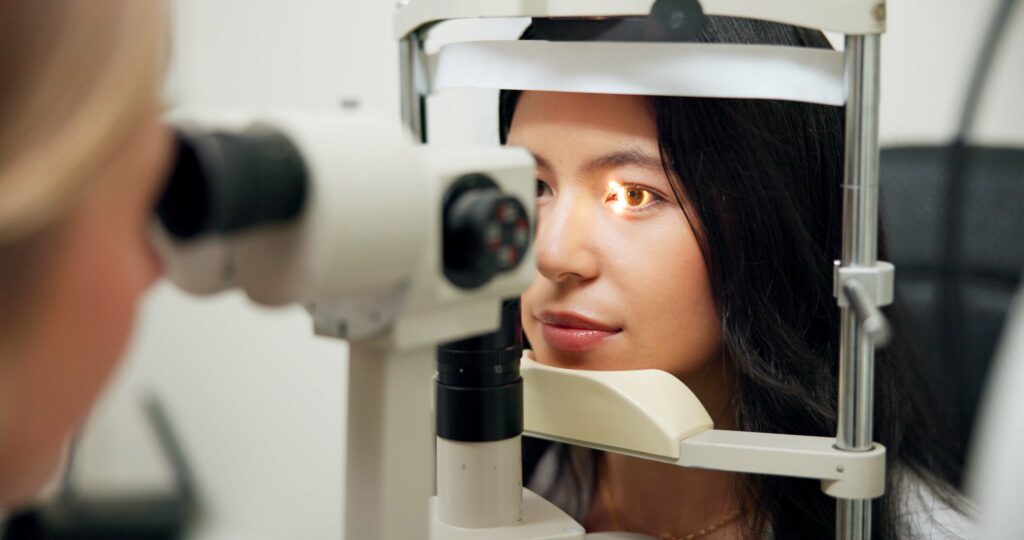


If you’ve ever sat behind a piece of optical equipment while your eye doctor asked, “which is better, one or two?”, you’ve already been through a refraction. It’s one of the most familiar moments in an eye exam, yet most patients don’t know exactly what it’s measuring or why the result matters so much.
What Does Refraction Mean?
Refraction describes how light bends as it passes through your eye’s lens and cornea on its way to the retina. When that bending is precise, images land clearly on the retina, and you see sharp detail.
When the bending is slightly off, images land in front of or behind the retina, and vision becomes blurry. That mismatch is called a refractive error, and the refraction test is how your eye doctor measures it.
How the Refraction Test Works
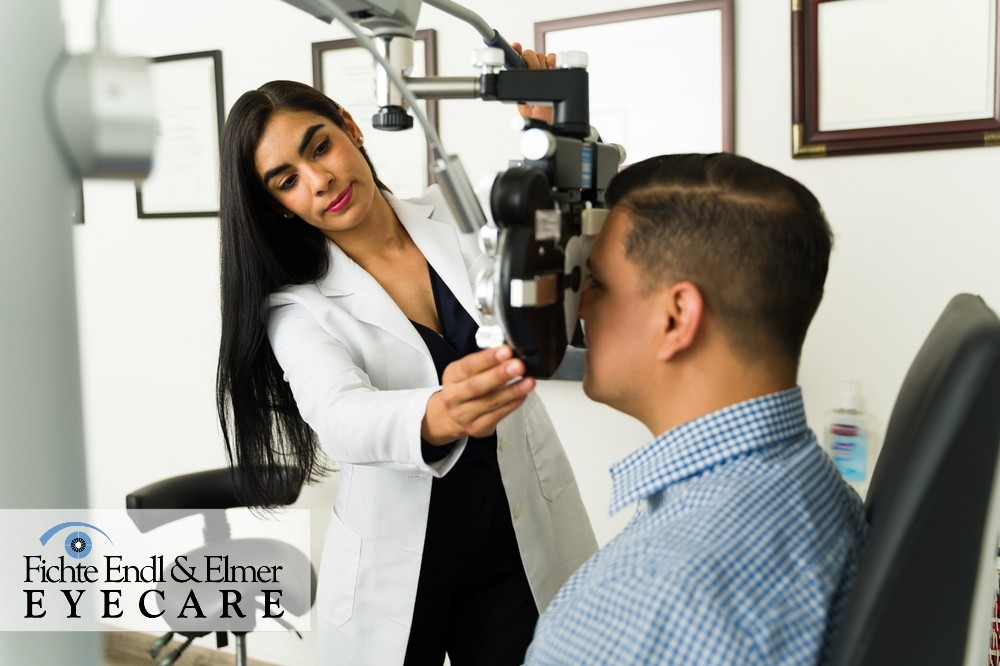
Your doctor will position a phoropter in front of your eyes. This instrument holds a series of lenses that can be adjusted in small increments. You’ll look at an eye chart across the room while different lens combinations are swapped in and out. For each pairing, you’ll be asked which option produces the clearest image.
The process feels simple, but the information it generates is precise. Your answers guide your doctor toward the exact lens power that corrects how your eye focuses light.
At Fichte, Endl & Elmer Eyecare, subjective refraction can also be performed remotely, using advanced digital exam stations that improve accuracy and efficiency for every patient.
What Refractive Errors Can It Detect?
The refraction test identifies the three most common refractive errors:
- Nearsightedness (myopia): distant objects appear blurry
- Farsightedness (hyperopia): close objects are harder to focus on
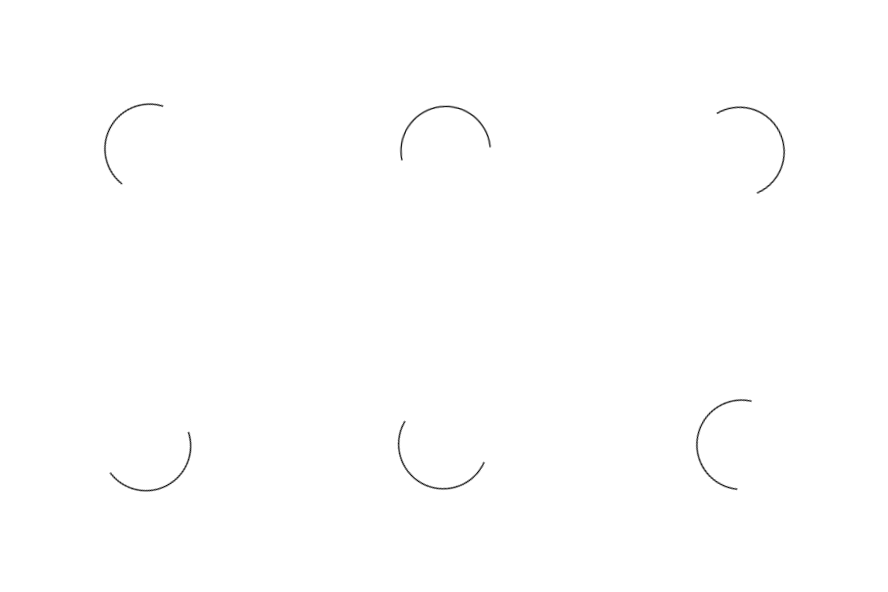
- Astigmatism: blurring at multiple distances due to an irregularly shaped cornea
The prescription generated from your refraction determines whether you need glasses, contact lenses, or whether you may be a candidate for a permanent solution like LASIK.
For patients frustrated with contacts in particular, knowing the exact degree of their refractive error is the first step toward understanding their vision correction options.
Is Refraction the Same as a Full Eye Exam?
Refraction measures how well your eyes focus, but it doesn’t assess the health of your eye’s internal structures. A comprehensive dilated eye exam includes additional testing aimed at detecting disease.
Tonometry checks intraocular pressure, which can signal conditions like glaucoma when elevated.
A dilated exam allows your doctor to examine the retina and optic nerve for early signs of macular degeneration, diabetic eye disease, and other conditions that don’t always produce noticeable symptoms.
Refraction is one important component of that broader evaluation, not a replacement for it.
Will Insurance Cover Your Refraction?
Coverage depends on the type of insurance or vision plan you have. Medical insurance and Medicare typically cover tests tied to a diagnosed eye condition, such as tonometry for suspected glaucoma or a dilated exam to monitor diabetic eye disease.
Routine refraction is a different category, and medical plans often treat it as a vision benefit rather than a medical one. If you have a separate vision plan, refraction is generally included as part of your covered routine eye care. If you only carry medical insurance, you may be billed for the refraction separately.
The best way to know for sure is to contact your insurance provider before your appointment to confirm what your specific plan covers, so there are no surprises when the bill arrives. The four most common vision plans in Western New York are VSP, EyeMed, Guardian, and Davis Vision.
Ready to schedule your next comprehensive eye exam? Schedule an appointment at Fichte, Endl & Elmer Eyecare in Buffalo, NY, or call us at 1-800-309-2020 today.